Grid View

Doctoral seminar on welfare technology, ageing and care: registration open for 2027–2028

AMICA doctoral researchers and other interested PhD students are invited to join Welfare Technology Innovation and Application in the Digital Age, a 5 ECTS doctoral seminar hosted by the University of Eastern Finland.

The seminar brings together an interdisciplinary, international group of researchers to explore how AI and technology can support ageing and care. Participants will present their own research, discuss others’ work and reflect on questions relating to welfare technology innovation and application.

Seminar details

  • Schedule: Nine Tuesdays between September 2027 and May 2028, from 14:00 to 15:30 Helsinki time
  • Format: Hybrid, with participation on campus at the University of Eastern Finland or via Zoom
  • Language: English
  • Credits: 5 ECTS
  • Assessment: Pass/fail
  • Prerequisites: None

To complete the seminar, participants are required to give one presentation, take one discussant role, contribute two shared readings and submit a reflection paper.

The seminar offers AMICA doctoral researchers an opportunity to develop their work through discussion with peers and researchers from different disciplines.

Register by 5 May 2027

Please complete the course registration form by 5 May 2027.

For questions, please contact Honglin Chen, Department of Social Sciences, University of Eastern Finland, at honglin.chen@uef.fi.

13 October 2026

This entry was posted in

Okategoriserade

Comments

0 Comments Leave a comment

New publication: Understanding vulnerability in AI-assisted care for older adults

When AI is used to support care for older adults, its ethical implications depend on how it becomes part of everyday practice. A prediction or alert acquires meaning through the information available, the people who interpret it, and the response it prompts. Responsible AI policy therefore needs to consider these care arrangements alongside the technology itself.

Consider a fictional example. A bed sensor detects more movement than usual during an older adult’s night and generates an alert. The record may capture movement while leaving out pain, worry or the person’s explanation. Staff need to interpret the alert and decide whether to respond. As it enters records and handovers, the interpretation may become an accepted account of that night.

Our AMICA paper, Vulnerability Intersections, published in The Gerontologist, offers a way to examine these relationships.

Discussions about AI in care often describe older adults as a “vulnerable group.” Our paper asks us to look more closely at how vulnerability arises. A person’s experience depends not only on their health or digital skills, but also on how a technology is designed, how care services use it, who has access to its information, and which rules govern it.

We call this approach vulnerability intersections. It brings together three levels: older people’s lives and experiences; care organisations and technology providers; and wider policy, economic, and regulatory conditions. It also recognises that advantages and disadvantages can build up over a lifetime. The framework helps researchers examine how AI shapes information about older people, the delivery of care, and people’s ability to participate in decisions that affect them.

As a conceptual paper, it gives the AMICA team a way to ask more precise questions as we study AI-assisted home care: Whose needs are being addressed? Whose views are missing? Where does responsibility lie when a system changes how care is organised? Our aim is to support care that uses AI thoughtfully while keeping older people’s experiences, choices, and relationships in view.

Read the open-access paper: Vulnerability Intersections: An Integrative Conceptual Framework for Understanding Vulnerability in AI-Assisted Care for Older Adults.

13 October 2026

This entry was posted in

Okategoriserade

Comments

0 Comments Leave a comment

AMICA’s Nordic–Baltic Consortium Meets in Lund

On 18–19 August 2026, AMICA partners met at Forum Medicum, Lund University, for the project’s first in-person consortium meeting. Across two half working days, the meeting covered all six work packages and addressed a shared challenge: how can AI-enabled home care be studied across different welfare systems without losing sight of the people, relationships and institutions that make care possible?

A shared method for cross-country comparison

One major focus in Lund was WP1’s institutional and policy work. The team is developing a catalogue of national and municipal documents – from laws and policies to procurement records, pilots, service deployments and administrative decisions – to examine how AI-enabled home care is governed and represented. At the meeting, the WP1 team worked to align a proposed process for identifying, recording, coding and interpreting evidence.

The programme also focused on AMICA’s planned research with innovation leaders, older adults and care workers. WPs 2-4 brought draft interview guides to the meeting for review and refinement.

From alignment to fieldwork

Next steps combine continued preparation with interview guides, ethics applications, and analysis. Protocols will support comparison while national teams adapt language and interpretation to local institutional contexts. The Lund meeting brought progress and next steps across all work packages into a shared discussion.

29 August 2026

This entry was posted in

Project updates

Comments

0 Comments Leave a comment

AMICA Kicks Off: A Nordic–Baltic Collaboration Shaping the Future of AI in Home Care

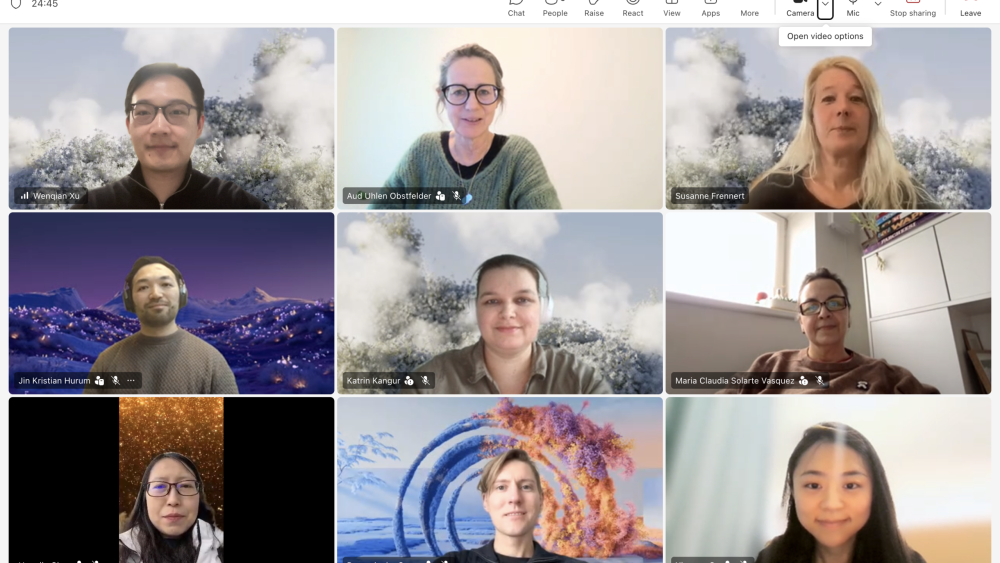
We were delighted to hold the kick-off meeting of the AMICA (AI for Mindful Care and Ageing) project on 2 March, bringing together our consortium partners to officially launch the project online.
AMICA is a four-year research collaboration funded by NordForsk. The project forms a Nordic–Baltic collaboration between Lund University (Sweden, coordinator), Tallinn University of Technology (Estonia), Norwegian University of Science and Technology (Norway), and the University of Eastern Finland (Finland). The consortium will explore how artificial intelligence may shape the future of home care in ageing societies.
During the meeting, the team discussed shared research interests across the participating researchers. We also recapped the project’s work packages, discussed key steps ahead, and outlined timelines for the work over the coming years. The meeting also included discussions on developing a conceptual paper and preparing shared interview guides for upcoming studies, as well as coordinating practical aspects of the research.
We are currently in the process of recruiting PhD students for the project and look forward to welcoming them soon!
Our first in-person consortium meeting is planned for 18–19 August in Lund, where we will work collaboratively on key research activities, including interview guides, policy analysis, and other project tasks.
It was inspiring to see such strong collaboration from the very beginning. We look forward to the exciting work ahead and to strengthening this Nordic–Baltic collaboration over the coming years!

27 January 2026

This entry was posted in

Project updates

Comments

0 Comments Leave a comment